
Modern organisations operate across cloud services, endpoints, email, identity systems and increasingly complex networks. That spread creates more places where unusual activity can appear and more signals for security teams to interpret. Traditional rules remain important, but fixed indicators cannot describe every new technique or every legitimate variation in behaviour. Darktrace is known for a security approach centred on learning patterns inside an organisation and identifying meaningful deviations from those patterns. The broader lesson is that context matters. A single event may look harmless on its own while a sequence of unusual actions across several systems can indicate a developing problem.
Security needs context as well as alerts
Alert volume is one of the practical challenges in security operations. A team that receives too many low-value notifications can spend valuable time sorting noise while higher-risk activity waits for attention. Behavioural analysis attempts to improve that prioritisation by asking whether an action is unusual for a particular user, device or workload. Darktrace applies this idea across different parts of the digital environment. The value of the model depends on good visibility and thoughtful deployment. Security teams still need clear asset ownership, reliable logging and policies that define what actions are acceptable when an anomaly requires investigation.
Normal activity is different in every organisation
Normal activity varies considerably between organisations. A large data transfer may be expected for a backup server but suspicious for an employee account that has never moved large files. A login at an unusual hour can be harmless for a global team and concerning in another context. Darktrace emphasises organisation-specific behavioural understanding, which highlights why baselines are useful. They provide a reference for interpreting change without assuming that every unusual event is malicious. Baselines also need ongoing observation because businesses evolve. New applications, acquisitions, remote work patterns and automation can all alter what ordinary activity looks like over time.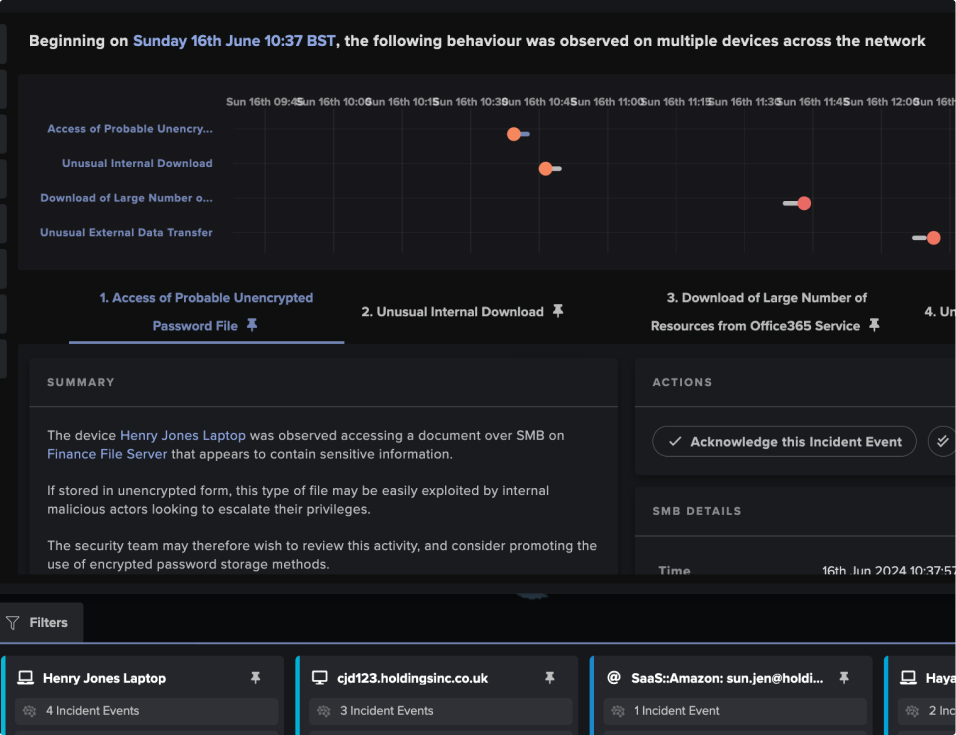
Automation should support human judgement
Automation can reduce response time when it is designed with boundaries. It should not replace governance or remove accountability from security decisions. A mature programme usually checks
– which systems are permitted to take automated containment actions and under what conditions
– how analysts can review the evidence that led to a high-priority alert or response
– how critical business services are protected from unnecessary disruption during containment
– how lessons from incidents are fed back into controls, training and architecture decisions
Darktrace positions automated investigation and response as part of a broader platform, but organisations still need human oversight that matches their risk tolerance and operational responsibilities.
Visibility works best across connected systems
Connected visibility becomes increasingly important when attacks cross boundaries. An identity event can lead to cloud access, email manipulation or lateral movement inside a network. Investigating each domain in isolation can hide the relationship between those steps. Darktrace brings behavioural context across multiple areas, illustrating the value of correlation when a security team needs to understand an incident as a sequence rather than a pile of separate alerts. The strongest security posture still combines technology with fundamentals such as patching, access control, backups and staff awareness. Behaviour-based detection adds another layer by helping teams focus on changes that deserve attention, especially when a threat does not match a familiar signature.
Behavioural systems also benefit from clear incident definitions. A team should agree what counts as a security incident, what requires immediate escalation and what can be reviewed during normal operations. Without that structure, sophisticated detection can still lead to inconsistent decisions. Roles matter as well. Network teams, identity administrators, cloud owners and legal or communications staff may all become involved depending on the nature of an event. Contact paths should be tested before a crisis because delays often occur at organisational boundaries rather than inside a security tool. Regular exercises can reveal whether evidence can be collected quickly, whether containment actions are authorised and whether critical services have exceptions that need special handling.
Measurement should focus on outcomes that improve resilience. Raw alert counts can be misleading because a falling number might reflect better controls or simply reduced visibility. More useful measures can include time to validate a high-risk event, time to contain confirmed activity, recurrence of the same root cause and the proportion of important assets covered by monitoring. Post-incident reviews can then connect technology findings with changes to architecture, access control or staff training. Behavioural detection is strongest when it contributes to that learning cycle. The organisation gains not only another way to spot unusual activity but also better evidence about how its systems are actually used. That evidence can support decisions about segmentation, privileged access, cloud configuration and the removal of outdated services that create unnecessary exposure.
Security architecture should also assume that some controls will fail. Layered access restrictions, tested backups and segmented systems can limit the effect of an incident even when detection is delayed. Behavioural monitoring then becomes part of a broader resilience strategy rather than a substitute for foundational controls. Clear ownership of corrective actions ensures that findings lead to measurable changes instead of remaining isolated inside security reports.